Showing posts with label Poland. Show all posts

Thursday, April 22, 2010

UK Tories to send gay MP to quell Polish social conservatives


Conservative party to send gay MP to quell EU extremists reports The Guardian. The story? Nick Herbert, Conservative MP for Arundel and South Downs, Tory spokesperson for the environment and one of several openly gay Conservative MPs has drawn the short straw and has agreed to go to Poland to attend a gay pride event in Warsaw in July (so far, so straightfoward) and also held the Tories' highly socially conservative ally, Law and Justice (PiS) embark on a 'journey' to modernize its negative views on homosexuality. Possibly a tall order. One of the founders of the PiS, Poland's late President Lech Kaczynski banned such events when mayor of the Polish capital. You have to feel sorry for Mr Herbert. He seems a nice guy. He met my mum when canvassing and was quite charming when she told he she was a dyed-in-the-wool social democrat, would like Gordon Brown as PM and a would not vote conservative if her life depended on it. I wonder if he will get on as well with Catholic social conservative in Warsaw as social democrats in Mid-Sussex.

Friday, January 01, 2010

2010: For whom the bell TOLs?

The BBC's annual Correspondents Look Foward programme has, characteristically, nothing to say about Central and Eastern Europe. It is now a backwater of global politics, seemingly. Even Russia barely gets a mention and the programme peters out with a self-indulgent discussion of the World Cup.

Transitions Online (TOL), does however, does carry a look ahead feature on CEE in 2010 but, unfortunately, it is scarely better than the BBC's non-discussion of the region. A translation of a commentary in the Czech economic daily Hospodářské noviny, it manages to serve up every cliche in the book about Central and Eastern Europe being rocked by a wave of nationalism and populism driven by economic crisis, which will hit harder in the region in the coming year.

Interestingly, the concrete developments that are flagged offer, as so often, a mixed picture: the Czech communists indeed may gain greater leverage after the Czech election, but they are hardly putting on the votes and this will depend on the electoral arithmetic and the decisions of the Social Democrats if they win (hardly evidence of a 'wave of extremism') . A Grand Coalition is frankly just as likely.

Hungary's election is likely to produce a sweeping win for the right putting paid for would-be reformist, centre left government led by a beleagued centre-left PM called Gordon B. - which sounds disconcertingly familiar, although in this case the wretched incumbernt is Gordon Bajnai and the third party is likely to be the far-right Jobbik. At last some genuine extremists on the up to give all that fire and brimstone some reality... However, although on 12% in the latest poll Jobbik seems unlikely to match the 14% it took in the Euro-elections. A historically good score of 10%, I should think, but the far-right has had electoral presence of around 5% previously and sat in parliament, so we are not in totally new territory here.

Robert Fico, perhaps the one sure thing in Central and East European politics these days, also seems set to romp home in the Slovak elections - and it seems that this bad boy of the European Socialist Group will indeed play the nationalist card and here too there is a far-right competitor of sorts in the Slovak National Party (SNS).

The game plan for anyone inclined to a favourable view of RF is that it's all in the good cause of dumping the Slovak Nationalists as a coalition partner and possibly out of parliament by incorporating some of their electorate into the political elephant that is SMER. Along with the seemingly unstoppable electoral juggernaut of Fidesz, Poland's Civic Platform, Bulgaria's GERB - a kind of centre-right parallel to Fico's interesting mix of mainstream respectability and edgy populism - SMER is now one of biggests and the highest polling party in the region, althoughs its 40%-ish ratings , which have actually been dipping a bit recently, pale before the 2/3 of the vote Viktor Orbán and his merry men (and women) seem set to pull in.

In any case, the real story seems to be one of big parties sweeping up votes by whatever means works, although yes, there is populism and nationalism about, this year as every year in the same way that there is grass in your garden. It is sometimes under control, n, occasionally grows and gets a big unruly and out of control, changes colour across the seasons and then gets cut again. It's not very lovely, and everything out there doesn't always look that rosy, but its part of the landscape and, of course, you don't have the option of paving it over and replacing the populace with a handpicked citizenry composed of liberal-minded financial journalists and economics PhDs

Happy New Year.

Friday, December 19, 2008

Poland: mirror mirror on the wall, who's the most social of them all?

The Warsaw Voice reports the latest political shenanigans around the law restricting Poland's currently wide ranging entitlements to early retirement. President Kaczynski has vetoed the bill, putting the small post-communist social democratic left in a (for once) important position: their votes would be needed by the liberal-peasant coalition govenment to overide the veto. Having looked like they might initially play the role of defenders of social welfare and big and early pensions, they now seem likely to opt for the role of modernizing opponents of the conservative-national right and help overturn the veto. Well, this is Poland, after all.

Thursday, November 06, 2008

Poland: retiring early retirement

The Warsaw Voice reports protests by trade unionists over the scaling back of early retirement schemes - one of the last remaining special social policies of the transition period intended - some say - to dampen down the possibilty of Latin American style social unrest. Probably the political system is stable enough, the government popular enough, the coffers empty enough and workers in declining heavy industies weak enough to allow this to happen now. Public sector workers may have few unpleasant surprises up their sleeves, but as events last year in Bulgaria showed, no one cares that much if the education system grinds to halt.

Friday, August 22, 2008

Communist ice (cream) age

The long shadow of the communist-era even reaches the ice cream stall at the Luhačovice municipal lido. My daughter wants a Helena ice cream - named after and endorsed by Helena Vondráčková, the politically conformist 1960s pop diva turned stalwart of normalization era light entertainment. Vondráčková looks about 20 on the wrapper, but must be well over 60. “Helena, she’s a famous Czech singer, kočičko”, the man at the stall helpfully explains to my daughter, who isn’t interested and also objects that she isn’t a cat. Curiously, the lolly is actually made in Poland. Presumably Vondráčková (her name is mis-spelled Vondráčkowá on the wrapper) has a few fans there . Meanwhile, as the anniversary of the 1968 invasion is near, on the radio they are playing a song by Marta Kubišová, another star of the Prague Spring era whose less than compliant attitude to normalization led to two decades of obscurity before 1989. She is a better singer, but doesn’t have an ice cream named after her.

Sunday, November 18, 2007

Poles together on the EU - probably

Friday morning found me sitting in the slightly faded elegance of a high ceilinged Georgian drawing room in the Polish Embassy in Grosvenor Square which served as venue for the Poland and the EU conference. The audience of about 100 is a varied mix Polish(-descended) or Polish-oriented academics, researchers, journalists and students with smaller scattering of people such as myself for whom Poland is just part of a wider East Central European beat. The morning began with an address from the Polish ambassador, Barbara Tuge-Erecińska, who stressed the commonality of interests between Poland and the UK on the future direction of the EU and the positive role that opening of UK labour markets has had in promoting Britain in Poland. A super-effective piece of public diplomacy worth any amount of more conventional initiatives, we were given to understand, although - she was far too diplomatic to mention - an inadvertent side effect of British civil servants' underrestimation of numbers of Poles likely to come to the UK after accession.

The conference proper was kicked off by Aleks Szczerbiak with a presentation on Polish public opinion and the EU. Fresh from disillusioning liberal minded Polish students at SSEES with anticipations that Civic Platform would quickly splinter and Law and Justice might prove a political heavyweight that was down but not out, Aleks again offered a slightly against-the-grain take on Polish politics. Despite the high (and growing) popularity of the EU among much of the Polish public and the rise of the europhile Civic Platform and (crushing of anti-EU parties like the League of Polish Families (LPR) and Self-Defence) in last month’s elections, Polish europhilia was more a happy coming together of different factors than a profound trend. Public expectations in the run up to accession had been low and - thanks to the British and Irish governments’ politically miscalculated opening of their labour markets to new CEE member states - membership had delivered in precisely those areas where it was popularly offering the greatest immediate benefits: opportunities for Poles to work and study abroad. As agricultural subsidy for new member states came on tap, farmers had also gained far more on balance than they had anticipated. Moreover, Aleks argued, the Polish public still tended to view its country’s EU membership in somewhat brutally self-interested and instrumental terms as a source of external funding and a battleground for national interests. There was also an underlying concern about the position and power of Germany in the enlarged EU. In the longer term, I understood, there was still space for a revival of some form of euroscepticism. Moreover, as he later pointed out in the Q and A, high levels of trust in the EU and EU institutions are essentially the flip side of engrained distrust in national institutions: europhilia might - I understood - simply be a side effect of the dysfunctionality of Polish democracy (even EU membership formally gives it a Western seal of approval)


Jacek Kucharczyk of the Warsaw-based Institute of Public Affairs (ISP) offered a slightly more sanguine assessment: there had, he suggests, been a genuine shift in Polish public opinion following accession and the pre-accession period he suggests would in hindsight come to be seen as the high watermark for radical eurosceptic parties like Self-Defence and the LPR; the crushing victory of Civic Platform was significant both as expressing a desire to express Polish Europeaness and national identity in new terms and in bringing to power a europhile liberal-peasant coalition with roots in co-operation in the European Parliament as part of the sprawling EPP faction; Europe was, moreover, an issue too lacking in salience to ever re-engage Polish voters, even assuming it ever engaged them in the first place (the rise of eurosceptic parties being, as several questioners later pointed out, more a facet of domestic issues, rather than concern over the EU per se). Simona Guerra then concluded the session with some discussion of focus research among students in Poland on attitudes to the EU: there are interesting regional variations and at aggregate level interesting correlations between Catholicism/religiosity and support the EU, most practicing Catholics tending to favour integration.

The conference then broke for lunch and - after a very tasty Polish buffet and an interesting conversation about the shift from the ‘JP2 [= John Paul II] generation’ to the ‘MP3 generation’ in Poland - I made a break of my own for Kings Cross to get home in time to take my daughter to Brownies. How many of these Polish-centred judgements, I wondered looking dozily out of the train window on the way home, were applicable more widely to other New Members States?Most lacked Poland's size and sense of historical importance; Slovaks and Latvians had however, reaped a similar migration premium, Romanians and Bulgarians will not (at least in the immediate post-accession period); many Czechs might share the underlying discourse of 'national interests' and anxieties over Germany that seem to inform Polish debates at an underlying level.

Monday, October 29, 2007

Will Europe's real liberals please step forward?

An interesting discussion of the similarities and dissimilarities between Britain’s Liberal Democrats and Poland’s Civic Platform
(PO) written by Ed Maxfield appears on the Lib Dem Liberal Voice website followed up by very intersting and intelligent discussion of the highways and byways of - that lost tribe of European politics - the liberals as European party family. Given some less than liberal social position and desire for a flat tax revolution, it strikes that PO are more Cameroonian conservatives minus the upper class social baggage, or perhaps an equivalent of the party that would emerge of the dull kaleidecsope of British (actually English) party politics got shaken up and some of the more assertively free market Lib Dems teamed up with some of the more socially liberal, decentralist Tories to form a kind of Blue-Orange Alliance (interestingly, the campaign colours of both Civic Platform and fellow Czech liberal-conservatives/conservative liberals in the Czech Civic Democrats) . I guess that would leave the hang ‘em and flog ‘em rump of the Tories as a kind of English nationalist Law and Justice party. The analogy, of course, breaks down because of the strength of the British social democratic left, which - despite a close shave in 1983 – has refused to go down the tubes electorally in the manner of post-communist parties in Poland, Slovakia and (possibly) Hungary.

Wednesday, October 24, 2007

Polish elections: SSEES roundtable debates Civic Platform's (uncertain?) prospects

Meanwhile, before you can say ‘Jaroslaw Kaczynski’ there is a (well attended)roundtable on the Polish elections at SSEES, where Aleks Szczerbiak struck an interestingly sceptical note about the durability of Civic Platform’s victory. Donald Tusk’s party has, he thinks, perhaps put together an unfeasibly broad electoral coalition based more of rejection of the incumbent government than support for a liberal-consevative centre-right. It had hoovered up votes of those who incline to more to the post-communist left, which was wrongfooted by the speed with which early election were called. Moreover, the Kaczynski’s Law and Justice (PiS) party remained, he thought, remained a poweful force having gained both voters and voters in a way not wholly reducible to taking over the electorate pole-axed radical parties Self-Defence and the League of Polish Families (LPR) (cut loose by Radio Marija, which backed PiS). PiS, it was suggested also had a powerful and coherent conservative-national narrative based on the project of a ‘Fourth Republic’ cleansed of the pervasive influence of an informal establishment (Uklad) of left-liberal communists-turned-capitalists and shady characters. Tusk’s PO, by contrast, travelled rather light in terms of ideology stressing modernity and decency. The idea of young, educated migrants and the emergeny middle classes turned on conservative, rural Poland was something of a myth: only about 30, 000 of the 750, 000 Poles in the UK voted and thir liberal votes were probably counted out by the Law and Justice inclined ballots of a similar number of Polish Americans in the US. Moreover, any coalition with the Peasant Party (PSL) would be tricky, given the latter’s inclination to play hardball on all kinds of issues, ruthless extract policy concessions for their rural base and use state posts as patronage resources to sutain their party (Civic Platform want to decentalize and clean up, but I wondered can you really build or sustain a party in CEE these days without a dose of clientelism and patronage?). Civic Platform and its new government might like so many previous Polish election winners fall apart all too soon.

Others speakers, including my SSEES economist colleague Tomasz Mickiewicz who doubles as astute poltical analyst, saw PO as having better prospects. There was ample scope for privatization – about 20% of Poland’s GDP is still in the state sector, second only to Russia among post-communist states, apparently. (Ironically, Law and Justice’s Gaullist dislike of privatizition had deprived it of resources for its social spending commitments). Moreover, its rhetoric of European modernity and a free market with functional welfare, he thought had been effective – the party had managed to reinvent itself as something else other than a elite, secular liberal party indifferent to national tradition and religion. Mass emigration to the UK and Ireland had given Poles a clear sense of just how this could work – migrants might not count much electorally, but they were cultural vectors for change in small town and rural Poland, perhaps enabling PO to puncture PiS economically populist warnings of impoverishment all round. Apparently, some Poles also see Ireland's political model of two (broadly speaking) right-wing parties and a rump social democratic left as as desirable as its Celtic Tiger economic policies. Ireland's chronic patronage and clientelism probably also offer an (unintended) parallel...

The roundtable was finished off by a very fluent and engaging review of Polish foreign policy by Nat Copsey, who foresaw a change of tone in Poland’s EU policy as well as its external relations with Russia and Ukraine, masking a lot of underlying continuity. In part this was because the Terrible Twins’ foreign policy, while less than comptently managed, were less terrible in practice than their public comments often suggested.

Monday, October 22, 2007

Pole-axed: minor parties obliterated in Poland's election

Results from Poland’s electoral commission reveal a complete slaughter of minor parties: not only are once medium-sized formations like Self-Defence and the League of Polish Families cut down to extra-parliamentary minows, the niche fringe groups of (occasional) interest to me barely register: the Women’s Party comes in at a mere 0.27% and the pensioners’ party seems not even to have made it onto the ballot, although I note that an outfit called the Labour Party picked up 1%. Is this the country that put the Friends of Beer party into parliament?

Sunday, October 21, 2007

Polish elections: Polarization sends Civic Platform to victory

So, ‘early’ (actually much delayed) exit polls suggest, Poland’s Law and Justice (PiS) has been clobbered by the market liberal-conservative modernisers of Civic Platform (OP), predicted to clock-up a huge 43-45% of the vote compared to a mere low thirtysomething for PiS. If true, OP might even be able to form a single party majority government, although thinking back to how wrong the Czech exit polls were last year Donald Tusk would do well to put the champagne on ice and start thinking about who potential coalition partners might be. With the exception of the Peasant Party, all the usual minor parties (Self-Defence, League of Polish Families etc) seem to have been wiped out, with niche parties that interested me so much (Women’s Party, Pensioners’ Party etc) not getting a look in. The Polish post-communist left, however, seems set to demonstrate its usual resilience in the face of defeat and establish itself a medium-sized third force. However, the numbers actually shape up what is striking is how very polarised these elections are despite the presence of a PR electoral system in theory reasonably conducive to small parties - a tendency also very visible in Czech elections last year and, of course, long established in Hungary whose mixed half PR/half-first past-the-post system offers strong incentives for two-party/bloc politics. An additional factor may be the role of the media in 'presidentializing' and polarising party politics. The Tusk-Kaczynski TV debate (which Tusk won convincingly) appears to have played a major role in outcome both in the sense of exlaining who won and in reflecting and reinforcing a sense that the election was basically a two horse race. The Czech series of pre-election Paroubek-Topolánek TV duels last year, althought there was no clear winner, seems to have had the same polarizing effect,boosting the two main parties' vote at the expense of more minor playes

Thursday, October 11, 2007

Warsaw Voice: Polish government to lure migrants home

Just as a follow up to my earlier post on CEE politicians fishing for ex-pat votes, I see the latest issue of the Warsaw Voice carries the following story by Andrzej Ratajczyk:


"Luring Back Expat Workers
10 October 2007
As the country starts to suffer from labor shortages, the government is trying to entice expatriate Poles back home.With the economy growing at more than six percent and investment soaring, employers are finding it increasingly difficult to attract suitably qualified staff even though unemployment is still hovering around 12 percent. This is partly because thousands of Poles have gone abroad in search of greener pastures since several EU countries opened their labor markets to them. This has depleted some rapidly expanding industries and several regions of manpower despite wages having grown substantially.Foreign investors pumped 6.2 billion euros into Poland during the first half of this year, 27 percent more than over the same period last year. Foreign corporations created more than 31,000 jobs in Poland last year, more than anywhere else in Europe, according to Ernst & Young, and companies with foreign capital employ around 1.2 million people.More than 50 percent of the companies recently surveyed by KMPG are directly affected by labor shortages and half of them have lost staff to better pay and development opportunities abroad. What employers most need is people qualified in information technology, finance and logistics. The country is also short of machine operators, construction site workers, electricians, locksmiths and other skilled laborers. Poland is lacking around 300,000 skilled workers, mainly in the construction and services industries, according to the Migration Department of the Ministry of Labor and Social Policy.The ministry estimates that 1.2 million Poles are working abroad, mainly in Britain (310,000), Ireland and Germany (160,000 each). "According to our research, 20 percent of the 1.2 million Poles working abroad intend to return home, 20 percent want to stay abroad for good, and the remaining 60 percent are undecided," said Labor Minister Joanna Kluzik-Rostkowska during a recent conference on labor emigration. "We want to encourage them to come back. The average age of Poles working abroad is 26 and most of them are doing jobs for which they are overqualified. If Poland can offer them the right opportunities then they will return."The ministry has drawn up a program entitled "Return" which provides a range of incentives for returning Poles to start up their own businesses. These include a two-year exemption from paying income tax and contributing to disability pension and labor funds. Old age pension contributions will also be reduced by a third for those who work in firms employing fewer than nine people. Applicants must have been abroad for at least a year to be eligible."It's vital that we encourage people to come back now as people make that decision of whether to stay or return during their first five years in a foreign country," said Kluzik-Rostkowska. "This means that young Poles will be weighing up whether they want to return to Poland over the next two or three years." Kluzik-Rostkowska says that family policy and the labor and housing markets will have to be improved if emigrants are going to be lured back. The ministry has set up websites (www.powroty.gov.pl, www.migracje.gov.pl and www.polacy.gov.pl) outlining basic information about the countries where Poles are working as well as the employment situation in Poland. The ministry will also be setting up an EU-financed online employment bureau at the end of the year where employers will be able to post job vacancies and applicants will be able to submit their CVs.The ministry is also planning to open special informational and advisory outlets at Polish embassies in the countries where most Poles are working, to hold job fairs and promotional activities for emigrants, and to develop Polish education abroad so that emigrants do not lose their ties with their homeland.The government's efforts are driven by a number of factors not least of which is a desire to staunch the burgeoning brain drain. Lower GDP and higher inflation are the main long-term costs of economic emigration, according to a ministerial report on the subject.Reducing unemployment through emigration will strengthen the bargaining power of workers, and this may increase wages pressure in the current climate of rapid economic growth.Migration has its upside too. Monetary transfers to Poland stimulate the economy. The influx of foreign currency strengthens the zloty, improves the current-account balance, and makes Poland appear less risky in the eyes of foreign investors.Other benefits include increased demand for Polish exports, more business contacts and the work experience brought to Poland by returning emigrants.The main benefit of emigration, however, is a fall in unemployment."

Wednesday, October 03, 2007

Tusk in Tesco: Do expats hold the key to Poland's elections?

In a sign of the times, the leader of Polish right-wing liberal-conservative Civic Platform party, Donald Tusk - currently vying for electoral supremacy with the more conservative-nationalist Law and Justice party of the Kaczynski twins - dropped in a branch of Tesco in West London, where according to Gazeta Wyborcza (as far as I can understand it) he stepped into a blaze of flash photography and ‘caused a sensation’. He wasn’t there to do a spot of shopping, but to open a counter selling Polish groceries and - more significantly - follows in the footsteps of pro-market politicians from other EU countries, who have beaten a path abroad to campaign for the votes of a new young, well educated economic diasporas, who have turned their backs on high unemployment or low wages to seek better opportunities elsewhere. Nicolas Sarkozy, for example, addressed a rally of some 2000 French expats in London during his successful presidential campaign and Romanian politicians were, apparently, out and about in numbers before the last elections in Spain, where there are tens of thousands of Romanian guestworkers

In much political science the assumption is that emigrants have exercised an 'exit' option, rather than giving 'voice' by participating in politics - the terms come from a classic article by Albert Hirschman. That too alienated or under-resourced to want to participate in domestic politics even by voting, or become too detached from domestic politic to care. But as I mused to two of SSEES PhD students with Polish-Romanian interests yesterday and a colleague today, the whole ‘exit’, ‘ voice’, ‘loyalty’ trilemma was initially developed by Hirschmann in a study of from East Germany in the early 1970s and might not transfer too neatly to today’s EU28 of internet, satellite TV and Easyjet.

It is, of course, actually pretty hard to vote as an expat even if, like a large number of recent Polish arrivals, you’re in London within relatively easy reach of the Embassy, as even a couple hours off is beyond what most rational voters would be prepared to commit to exercise a vote even in a close fought and unpredictable campaign. My more canny colleague’s suspicions that ultimately such expatriate campaigning is really way for liberal parties to signal to those a home that a young generation is being 'wasted' abroad, than a serious attempt to harvest expatriate votes. Tusk told journalists he wasn’t in the UK simply to call on expat Poles to return home, but to convince them that (when he was in power) things in the homeland would change and they would ‘find their London’ in Poland. Still, he would it would be interesting to know the figures... The small expat Czech vote (small by Polish, Romanian or French standards) is widely believed to have tilted last year’s Czech elections narrowly towards the right

Though waxing lyrical about the free market and the fact that the Kaczynski’s rhetoric of social Poland was actually a bastardized form of socialism (shades of Václav Klaus, for whom pretty much everything he doesn’t agree with is a bastardized form of socialism) Tusk’s a programme offering returning workers various tax breaks when they resettle in Poland seems to suggest that he regards migration from Poland as a problem to be solved, rather than a reality to be accommodated, as I think Irish politicians do (or, rather did, in 1980s before the country started booming and sucking in workers from the new EU). However, in Ireland all is not completely well in the Polish--Tesco relationship. The radical Indymedia site reports wildcat strikes by Polish temps at a Tesco distribution depot in Dublin, so perhaps the assumption that young Polish migrants are disproportionately likely to vote for Tusk is flawed, anyway.

I suspect, however, that anyone who promises change - even in free market form - can still do fairly well among disaffected, footloose younger voters, however exploited they might be in Western Europe. Still, however good his policies Tusk wants to reap electoral dividends, he should probably think of about introducing Estonian style internet voting, rather than promising to turn to Polish economy round in five years.

Tuesday, September 25, 2007

Polish Women's Party set to spring electoral surprise?

Meanwhile, the surprise package of the Polish elections seems not to be the pernsioners party, but the newly formed Women’s Party (Partia Kobiet), whose Polish language website can be found here. Its founders semi-nude campaign posters have attracted the requisitie amount of outrage from the Church and (crucially) media coverage, including a report in The Times. Despite this media savvy crashing of the headlines, the party seems a politically very serious initiative and, interestingly, differs from women’s parties elsewhere in post-communist Europe in being more overtly feminist and intelligenstsia-based and less based on women’s organisations with roots in the old regime and preoccupied with fighting rearguard actions to defend socialist-era welfare provisions. Newness, media coverage, the backing of female celebrities and response to issues not well addressed in Poland's male-dominated political class may add to a recipe for political success for the Partia Kobiet, which (on a reported 3%) is positioned not too far off the 5% threshold needed to entered parliament and - more crucially - to overcome potential voters' concerned that a vote for the PK might be wasted on a non-parliamentary also-ran.

Tuesday, September 18, 2007

Poles set to surprise at the polls?

Polish politics moves so fast. One minute the ultra-Catholic League of Polish Families are allying with populist Self-Defence (PiS), the next thing they have teamed up with dissident MPs for the ruling Law and Justice party and – my SSEES colleague tells during a breath of fresh air during out staff awayday – the notionally liberatarian Union for Real Politics. As in 2001 the election is a ding-dong battle between populist inclined conservative nationalist PiS and the centre-right Civic Platform (OP), who are liberal-conservative bloc loosely in ther mould of the Czech ODS (although this time they are keeping stum about that belief in flat taxation, it seems, and stressing PiS authoritarian leanings and apparent abuse of the anti-corruption agency and police. Opinion polls going up and down with OP and PiS variously in the lead with each getting (usually) around 30% of the poll. Small parties have been squeezed. The remnants of the once mightly post-communist left have formed a Hungarian style left-liberal coalition (LiD) with the Democrats, descendants of the ex-dissident Freedom Union who crashed out of parliament in 2005. This grouping seems set to hang on in parliament as a minor party with around 10 per cent of the poll. The Polish Peasant Party (PSL) also seem set to do badly, with polls I have seen reported putting them on 3-5 per cent, suggesting they could go the same way. Indeed, in one poll, they were reportedly barely ahead of the National Pensioners Party (KPEiR) which registered a respectabe 3%. There is also a Women’s Party standing (1.6%). Both the result and the government seem, frankly, anyone’s guesss and, as ever, Polish elections seems set to generate surprises. Who knows it might even be worth putting a few zlotys on the Pensioners.

Tuesday, July 31, 2007

Populist Czech Christian Democrat leader is no Lepper

Aktualne.cz notes the parallels between the position of the minority centre-right Czech and Polish centre-right governments in managing junior partners mired in corruption allegations. Polish PM Jaroslaw Kaczynski can happily give populist Agriculture Minister and Deputy PM Andrzej Lepper the boot, whereas Czech PM Miroslav Topolánek has to hang on for dear life to Christian Democrat leader, Minsiter of Local Development and Deputy PM, Jiří Čunek. Despite the general respectability of the Czech Christian Democrats compared to Lepper’s radical Self-Defence party, Čunek (a former mayor elected to the Senate last year) is one a of a new breed of Czech populists with a background in communal politics, who have discovered that brutal remarks directed towards the Roma minority are something of a vote winner – perhaps because with the collapse of the Czech far-right as a national electoral force whose stock in trade they were they have lost their taboo status. The Czech Republic’s having safely joined the EU probably adds to this as well.

However (the Greens aside) it is the police investigation into Čunek’s alleged acceptance of a backhander as mayor seems to make him more of a political liabilty than his views on ethnic minorities. Sadly, for Topolánek such is the weakness of his government and the unhealthy state of the polls – the Czech Social Democrats, who have been slowly rising from the political dead since 2005, finally overhauled him – that he not only cannot pulled the plug of Čunek, but needs to maintain him politically. Whereas, the Kaczynskis’ Law and Justice party can bid goodbye to the radicals of Self-Defence and the League of Polish Families and seek the mainstream embrace of the liberal-conservative Civic Platform, the Czech right is painfully short of allies. As a seminar discussion on the CEVRO thintank site makes clear, the Czech Christian Democrats despite Čunek’s dose of populism are a stagnating rural Cathlic niche party with a static socially conservative electorate somewhat out of step with the more centrist and market-oriented oreitnation of its leaders.

Wednesday, July 18, 2007

Poland's LiS: a fox driven to ground

Well, a better informed colleague tells me, the LiS grouping is more of a fox driven to ground than a powerful populist predator likely to gobble up the voters of more mainstream parties - the League of Polish Families has dire poll ratings of 2-3% and Self-Defence is poised uncertainly over the 5% threshold needed to enter parliament. The whole project is more of a short-term electoral bloc in the best traditions of Polish pre-election hocus pocus than a true party merger. Both parties will apparently keep their own organizational structures and simply bolt on some kind of co-ordinating bodies. This given that both party leaders are also likely to keep their egos intact, suggests they will probably not keep the whole show on the road for very long.
Seems I have myself fallen into that the trap I often warn other people about of wishing powerful anti-market forces into existence, when the real story - in Poland as elsewhere - seems to be the political strength of more mainstream populists such as the Law and Justice party (Pis) able to hold a gun to the head of its erstwhile coalition partners by threatening them with early elections and probable political oblivion. Boom, boom, as Basil Brush would say.

Tuesday, July 17, 2007

Outfoxed? Polish populists make unlikely marriage

You could have knocked me down with a feather when I read (in the Slovak) press that Poland’s ultra-Catholic League of Polish Families (LPR) and raucous agrarian populist Self-Defence are to merge into a single grouping to be known as League and Self-Defence (LiS). This cumbersome title allows a punning acronym as ‘lis’ is the Polish for ‘fox’ and the new grouping was launched by Self-Defence’s Andrzej Lepper and the rather younger, smoother LPR leader Roman Giertych holding a cuddly toy fox, which vaguely reminded me of the mascot of the Czech mortgage company ČMSS (see below) or the ever popular British children's TV character, Basil Brush.

Politically speaking, the move is clearly a response to Self-Defence’s being chucked out of the conservative minority coalition government headed by Law and Justice Party of terrible twins Lech and Jaroslaw Kaczynski and, presumably, to the impending prospect of early elections where the LiS alliance might produce electoral gains (although the dividends of merged blocs are not always as high as their founders imagine). Although both Self-Defence and LPR are anti-liberal, anti-EU and perhaps more rural than urban, they strike me as rather unlikely bedfellows given the rather different social mileux they spring from and the fact that Self-Defence seemed to embody a fairly secular economic populism and relatively agnostic line on decommunization. Lepper’s comment that both groups would ‘retain their identity’ also seemed to contradict the sense of a merger, the organizational and financial mechanics of which would, given the best will in the world, be inevitably be tricky

Thursday, June 28, 2007

BBC World Service: Poles apart on lustration

Excellent report on lustration and decommunization issues in Poland on BBC World Service’s Assignment programme accessible here. Interesting how in challenging Poland’s ‘forgiving’ lustration settlement - in which telling the truth about collaboration with the dark repressive side of the regime mattered more than collaboration itself - right-wing forces are re-treading tactics of the Czech anti-communist right in the early 1990s. The ‘wild’ publication of list of collaborators etc

Friday, October 13, 2006

"New elections please, duck" say Polish liberals

Despite the conventional wisdom about flat, stunted civic societies in Central and Eastern Europe, as Petr Kopecký and Cas Mudde suggested in an excellent edited collection a few years ago (Uncivil Society?, Routledge, 2002) waves of civic mobilization do break over CEE fairly regularly. These days, more often than not, however, they are semi-orchestrated by liberal and right-wing parties trying to depict opponents as authoritarian throwbacks threatening democracy against whom a 'new 1989' is needed. The militant right-wing Hungarian protest culture - which first emerged in full view with the founding of the 'civic circles' movement in 2002 after the right narrowly lost elections and has gained a new lease of life with the Hungarian Socialists PM's unwisely candid remarks that he had lied to win the election about a 'fucked up' economy (A European Commission report confirms Hungary has the worst fiscal stats in the EU - those other neo-liberal refuseniks, the Czechs and Slovenes do quite badly as well).

Now, reports OpenDemocracy, Poland's liberal Civic Platform (OP) party is co-ordinating citizen protests to press ahead with a scheduled parliamentary vote on holding easrly elections against the wishes of the conservative-nationalist government of the Kaczynski brothers (President and PM respectively) which also includes the ultra-conservative League of Polish Families (LPR), who also do their own in right-wing Christian line counter-protes. The minority coalition was recently unstuck by the secret taping of an injudicious attempt to 'buy' an MP from another party (a practice not totally unknown in Czech politics, although despite murky accusations hard evidence has never emerged) Playing on the Kaczynski surname and Polish word for duck, the movement has the witty slogan "Sorry, Kaczory, jutro wybory!, which (I think) means"Sorry, ducks, elections tomorrow".

Monday, May 15, 2006

Polish students protest, Czech Greens self-destruct


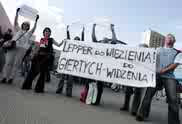
Don't knock the French language press. Reading through an unwanted copy of Libération picked up in the Eurostar I see with some interest that in Poland there have been spontaneous protests of 2000-3000 high school and univerity students against the appointment of the League of Polish families leader Roman Gertych as Education Minister. Turning with trepidation given with my non-existent Polish to the online edition of Gazeta Wyborcza some guesswork and a Czech-Polish dictionary suggests a rather interesting social movement in the making http://serwisy.gazeta.pl/wyborcza/1,34513,3342116.html and with regional demonstrations planned at provinical universities. The big story for GW seems to be the use of internet and SMS to co-ordinate the protests, but this seems fairly well established as for example in the right-wing 'civic circles' movement organized by Fidesz (now narrowly defeated the left again despite its conservative-nationalist civic mobilzation).

No mention of events in Poland in the British press and more distrubingly not a word about the the killings in Antwerp, although the latter is picked up by Lidové noviny in Prague despite the ongoing Czech elections. Here, the centre-right's prospects of forming a coherent administration with the Christian Democrats now depend on the Greens - this year's surprise package - not making it into parliament. The Czech Greens themselves seem to be try to oblige by banging energetically on the self-destruct button a fortnight before polling. Czech media report a renewed bout of faction fighting in the party in the form of a open letter critizing the leadership's neglect of the grassroots signed inter alia by veteran human rights activist, ex-Human Rights Ombudsman and one time revolutionary socialist Petr Uhl. Two Green party members thumping each other at a party meeting after 'inappropriate comments' (political in nature apparently) one made about the other's spouse, who is running in the election. Perhaps it is just the right-wing press targetting the Greens, whose 'indiscipline' , 'instability' and lack of 'legibility' has been trumpeted across the political spectrum since their breakthrough in the opinion polls in February.

I can't help feeling we won't be seeing Central Europe's first Green deputies for decade come 4 June...
Blogged.com